
Turf Burn Prevention Screens: Stopping Window Glare From Melting Your Artificial Turf in Phoenix
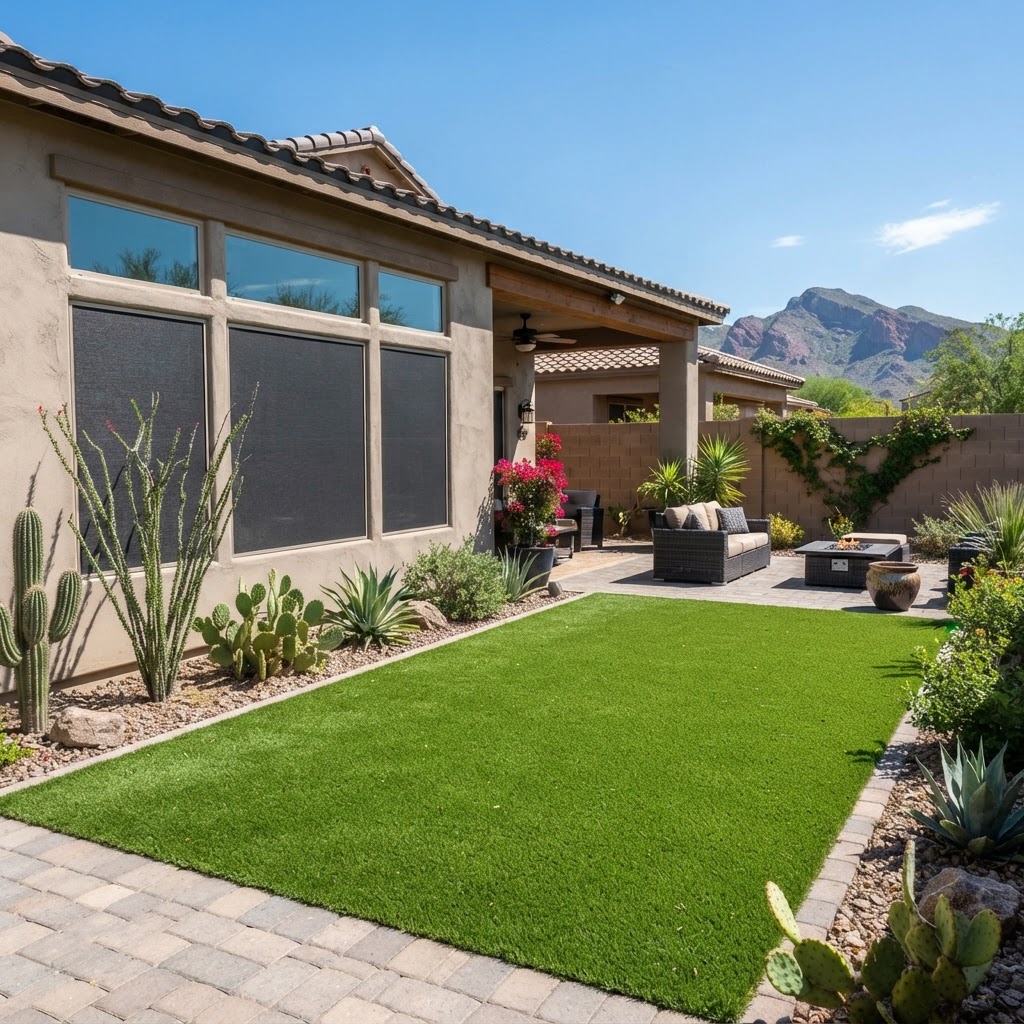
Energy-efficient Low-E windows reflect concentrated heat and light the same way a magnifying glass does, and when that reflection lands on artificial turf it can melt or scorch the blades in a fixed spot that gets worse every summer. If you've noticed a shiny, warped, or discolored patch of turf that always shows up in the same place near a window, your glass is almost certainly the cause — not a drainage problem, not a bad turf install, and not something a turf cleaning will fix.
This is one of the more frustrating problems for Phoenix Valley homeowners, because the turf itself did nothing wrong. The window is doing exactly what it was designed to do — reject heat — and in the process it throws a magnified hot spot onto whatever sits in its reflection path.
Why This Happens More in the Phoenix Valley Than Anywhere Else
Low-E (low-emissivity) glass has a microscopically thin metallic coating that reflects infrared heat back outward instead of letting it pass through the window. That's great for your energy bill. It's also why dual-pane Low-E windows have become standard in nearly every new Valley build since builders started chasing better energy ratings.
The problem shows up when that reflection concentrates onto a single spot instead of scattering. A flat window with the sun at the right angle acts like a mirror and a lens at once, and synthetic turf — built from polyethylene and polypropylene fibers — starts to deform well below the temperature of real grass, which simply doesn't exist to melt. Combine Arizona's sun angle, 100+ days a year above 100°F, and the Valley's near-universal use of turf for water savings, and you have the exact conditions that cause this damage somewhere in nearly every HOA community from Surprise to Queen Creek.
Signs Your Window Is Burning Your Turf
- The damage is always in the same spot. Turf burn doesn't move around the yard; it tracks a fixed reflection path from a specific window or sliding door.
- The blades look melted, not just faded. Sun-faded turf dulls in color evenly. Burned turf shows shiny, hardened, sometimes fused blades — it looks closer to a plastic that's been near a flame.
- It's worse on hot, clear afternoons. Overcast days don't produce the same damage, which rules out general UV fading as the sole cause.
- It appears near large Low-E windows, sliders, or pool-facing glass. South- and west-facing openings with an unobstructed line to the yard are the most common sources.
If you want to confirm it before spending money on a fix, watch the suspected window on a sunny afternoon and look for a bright, concentrated glare on the turf itself — not just general sunlight, but a distinct hot spot you can see from across the yard.
How Turf Burn Prevention Screens Stop It
Turf burn prevention screens are mounted on the exterior of the window, over the Low-E glass, rather than relying on anything applied to the turf itself. The screen breaks up and diffuses the reflected light before it ever concentrates into a beam, so the glare that would otherwise focus on one patch of turf gets scattered across the mesh instead.
This is a different job than a standard solar screen. A solar screen is tuned to cut heat and UV coming through the glass into your home. A turf burn prevention screen is tuned to interrupt heat reflecting off the glass and back out into the yard. Both can live on the same window, and for homes with both a hot room and a turf burn problem, that's often exactly what we install.
Where We See This Most in the Valley
- South- and west-facing patio sliders overlooking a backyard putting green or turf lawn
- Pool-adjacent windows, where reflected light off the water can compound the glass reflection
- New-build communities in Buckeye, Queen Creek, San Tan Valley, and Surprise, where Low-E glass is standard and turf is the default landscaping choice
- Two-story homes where a second-floor window reflects down onto a ground-floor turf area at a steep, concentrated angle
Turf Burn Prevention Screens vs. Other Fixes
- Turf burn prevention screens — Stops the reflection: Yes · Keeps the window usable: Yes, view and airflow retained · Cost: Moderate, per opening · Notes: Addresses the cause at the source
- Relocating or re-piecing the turf — Stops the reflection: No · Keeps the window usable: Yes · Cost: Low, but recurring · Notes: The new patch burns again on the same schedule
- Switching to a heavier, heat-resistant turf backing — Stops the reflection: Partially · Keeps the window usable: Yes · Cost: High · Notes: Raises the melting threshold but doesn't eliminate the reflection
- Exterior window film — Stops the reflection: Partially · Keeps the window usable: Yes, slight tint · Cost: Moderate · Notes: Can reduce some glare but isn't designed for this specific reflection problem
- Shade sails or patio covers — Stops the reflection: Only where shaded · Keeps the window usable: Yes · Cost: Moderate to high · Notes: Doesn't help turf that sits outside the shade line
For most Valley homes, a properly placed screen on the offending window is the most direct fix, because it stops the reflection at its source instead of working around the symptom in the yard.
What to Check Before You Buy
- Has the actual window been identified? Guessing wrong means paying for a fix that doesn't touch the real source.
- Is the screen rated for exterior mounting in direct Arizona sun? UV-stabilized mesh matters here just as much as it does on a solar screen — a screen that degrades in a few summers stops helping long before you expect it to.
- Will it change the look of the window from inside or outside? Ask to see a sample panel before committing, especially on street-facing elevations where HOA appearance rules apply.
- Does your HOA require an architectural request? Many Valley HOAs treat exterior screens the same as solar screens for approval purposes — check before installation, not after.
What It Costs
Pricing depends on the window's size, height off the ground, and whether it's a standard opening or an oversized slider wall. Because these are built and mounted to the specific opening rather than pulled off a shelf, we measure on-site and quote per window so you're only paying to fix the opening that's actually causing damage.
Stop Replacing the Same Patch of Turf Every Year
Window Screen Guys installs turf burn prevention screens for homeowners across Phoenix, Scottsdale, Chandler, Gilbert, Surprise, Peoria, Buckeye, and Queen Creek. We'll identify the exact window causing the damage, confirm it on-site, and quote a screen built for that opening — Licensed Arizona contractor, ROC #362719.
Call (480) 771-6091 or request a free on-site quote.
Need solar screens, bug screens, or pet screens for the rest of the house at the same time? Configure and price those yourself online at Screens2Go.
Frequently Asked Questions
How do I know if my window is actually causing turf burn?
Look for a fixed, concentrated glare on the turf on a sunny afternoon, coming from a specific window or slider rather than general sunlight. The damaged patch stays in the same place every time and tends to look shiny or melted rather than simply faded. If you're not sure, we can confirm it during an on-site visit.
Will a regular solar screen fix turf burn?
Not reliably. Solar screens are designed to cut heat and glare coming through the glass into your home, not the heat reflecting off the glass and out into the yard. A turf burn prevention screen is built specifically to diffuse that outward reflection.
Can I just replace the burned turf instead of fixing the window?
You can, but the new turf will burn in the same spot on the same schedule, because the reflection causing the damage hasn't changed. Replacing turf without addressing the window is a repeating cost.
Does this only happen with Low-E windows?
Low-E glass is the most common cause because its reflective coating is specifically designed to bounce heat back outward, but any window or glass surface can create a concentrated hot spot depending on angle, size, and orientation. Low-E just makes it far more common in newer Valley construction.
Will a turf burn prevention screen make my window look different?
There's a visual change similar to a solar screen, though the screens used for turf protection are selected for the specific reflection problem on that window. We'll walk you through sample panels so you know what to expect before installation.
Does my HOA need to approve this?
Many Phoenix Valley HOAs require an architectural request for exterior screens, especially on street-facing elevations. We can tell you what's typically required in your community, but the HOA's current rules are the final word.
Need help with your windows?
Shop Screens2Go