
Should You Remove Solar Screens in Winter? A Phoenix Valley Homeowner's Guide
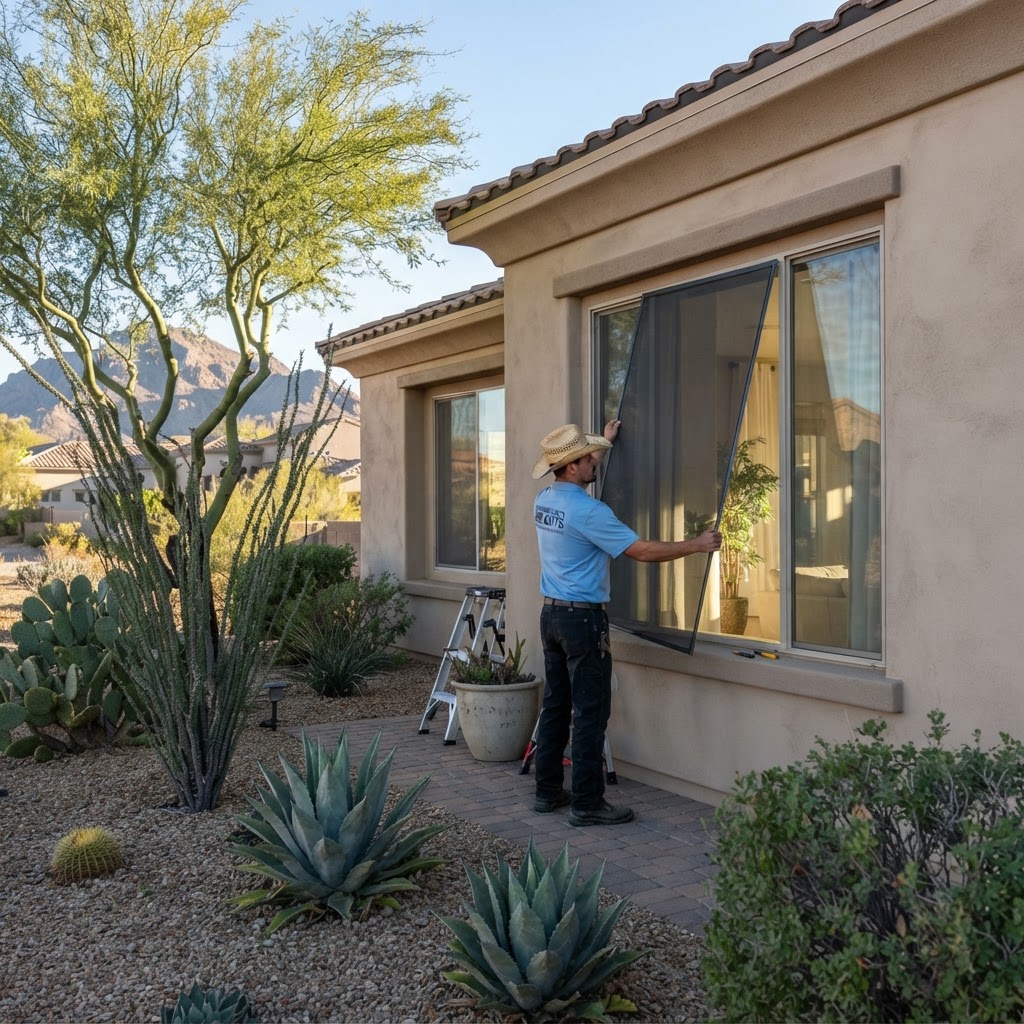
For most Phoenix Valley homes, you should not remove solar screens in winter — our winters are short and mild, cooling costs dwarf heating costs, and taking screens down every year adds wear, storage hassle, and bent frames. The one real exception: a few large south-facing windows in rooms you want warmed by the low winter sun. Here's how to decide window by window.
The Short Answer
- West- and east-facing windows — Recommendation: Leave solar screens up year-round
- North-facing windows — Recommendation: Leave up (little direct sun either way)
- Large south-facing windows in living areas you want warmer — Recommendation: Consider swapping to a standard bug screen Nov–Feb
- Second-story screens — Recommendation: Leave up — not worth the ladder risk
- Snowbird / seasonal homes left empty — Recommendation: Leave up — protects interiors from UV fade while you're away
- HOA-regulated street-facing windows — Recommendation: Leave up — avoids mismatched exteriors
Why Leaving Solar Screens Up Usually Wins in the Phoenix Valley
In colder climates, homeowners pull solar screens in fall so winter sun can heat the house for free. That logic doesn't transfer well to the Valley:
- Winter is short. Phoenix typically sees daytime highs in the mid-60s to low 70s from December through February, and the heating season is only a few months. By March, many homes are already running the A/C on warm afternoons.
- Cooling dominates your energy bill. Arizona homes spend far more on summer cooling than winter heating, so a screen that blocks up to 80–90% of solar heat earns its keep for most of the year.
- UV doesn't take winter off. The desert sun still fades flooring, furniture, and artwork in January. Solar screens keep blocking UV regardless of season.
- Glare is worse in winter. The sun sits lower in the sky, so it shines deeper into rooms and straight into TVs and monitors. Solar screens cut that glare.
- Removal causes damage. Every time a screen comes down, it risks bent frames, broken plunger pins, and torn spline. Stacked in a hot garage, frames can warp — and a warped frame won't seal when it goes back up.
- Privacy stays intact. Solar mesh provides daytime privacy from the street, which disappears when you swap to standard bug screen.
When Removing (or Swapping) Solar Screens Makes Sense
The low winter sun enters south-facing windows at a steep angle — that's the one place a solar screen meaningfully reduces free winter warmth. A swap can make sense if:
- The window faces south (or close to it) with no overhang, tree, or patio cover shading it.
- It's a room you actually use during the day — a living room, kitchen, or home office.
- The screen is on the ground floor and easy to reach.
- You have somewhere flat, shaded, and dry to store the screen.
A better option than bare glass: swap the solar screen for a standard or fine-mesh bug screen for the winter months. You keep bug protection on cool evenings with the windows open, and you let more sunlight in. Many Valley homeowners order a second set of bug screens for their south windows from Screens2Go and rotate them twice a year.
How to Remove and Store Solar Screens Without Damaging Them
If you do pull a few screens, do it right:
- Label each screen with masking tape — room, window, and which way is up.
- Remove from the inside where possible. Squeeze the plunger tabs or push up and swing the bottom out — don't pry the frame.
- Rinse off dust with a garden hose and a soft brush (no pressure washer). Let it dry fully.
- Store flat or upright against a wall, never with weight stacked on top.
- Keep them out of a hot attic or sun-baked shed. A climate-controlled closet or shaded garage wall is best.
- Reinstall by early March, before the first 90-degree days.
Your Winter Solar Screen Checklist (Even If They Stay Up)
Winter is the best time of year to service screens in Phoenix — it's comfortable outside and shops aren't slammed with summer rush orders.
- [ ] Rinse monsoon dust and haboob debris off every screen
- [ ] Check for tears, sagging mesh, or loose spline
- [ ] Look for bowed frames that leave gaps at the edges
- [ ] Confirm clips and plunger pins are holding tight
- [ ] Inspect for hail damage from fall storms
- [ ] Replace sun-rotted or brittle mesh before summer heat returns
If a screen is torn, faded, or warped, replacing it in winter means you're ready before cooling season starts. You can price replacement solar screens instantly at Screens2Go — the Valley's online option for custom replacement screens, with shop pickup or local delivery.
Solar Screens vs. Bug Screens in Winter
- Blocks solar heat — Solar screen (80–90%): Up to 80–90% · Standard bug screen: Minimal
- Lets in winter warmth — Solar screen (80–90%): Low · Standard bug screen: High
- Cuts glare — Solar screen (80–90%): Yes · Standard bug screen: Slightly
- UV protection for interiors — Solar screen (80–90%): Strong · Standard bug screen: Minimal
- Daytime privacy — Solar screen (80–90%): Yes · Standard bug screen: Limited
- Bug protection — Solar screen (80–90%): Yes · Standard bug screen: Yes
- Best winter use — Solar screen (80–90%): West, east, and second-story windows · Standard bug screen: Unshaded south windows in living spaces
Serving Homeowners Across the Phoenix Valley
Window Screen Guys builds custom solar screens, bug screens, and screen doors locally and serves Phoenix, North Phoenix, Scottsdale, North Scottsdale, Peoria, Surprise, Glendale, Cave Creek, Anthem, Mesa, Chandler, Gilbert, Tempe, Goodyear, and Buckeye. Licensed Arizona contractor, ROC #362719.
Get Your Screens Ready Before Summer
Not sure which windows should keep solar screens and which could use a winter bug screen? We'll look at your home's exposure and give you a straight answer.
- Want it done for you? Request a free quote for measure-and-install service, or call (480) 771-6091.
- Prefer DIY? Configure custom solar or bug screens with instant pricing at Screens2Go and pick them up or have them delivered.
Frequently Asked Questions
Should I take down my solar screens in the winter in Phoenix?
Usually not. Phoenix winters are short and mild, and cooling costs far outweigh heating costs for most Valley homes. Leaving solar screens up keeps blocking UV, glare, and heat on warm winter afternoons and avoids frame damage from repeated removal. The main exception is a large, unshaded south-facing window in a room you want warmed by winter sun.
Do solar screens make your house colder in winter?
They reduce the amount of free solar heat that enters through the window, so a room with sun-facing windows may feel slightly cooler on sunny winter days. In the Phoenix Valley, the effect is modest because winter is short and many homes still need cooling on warm afternoons.
Which windows benefit most from removing solar screens in winter?
South-facing windows with no overhang, tree, or patio cover. The low winter sun shines directly into these windows, so swapping a solar screen for a standard bug screen lets in more warmth and light. West, east, and north windows generally gain little from removal.
Can I swap solar screens for regular bug screens in winter?
Yes. Many homeowners keep a second set of standard bug screens for south-facing windows and rotate them seasonally. You can order custom-sized bug screens online at Screens2Go (screens-2-go.com) using your existing screen measurements.
How should I store solar screens I remove?
Label each screen, rinse and dry it, and store it flat or upright in a shaded, climate-controlled space with nothing stacked on top. Avoid hot attics and sheds, where Arizona heat can warp aluminum frames.
When should I put solar screens back up in Arizona?
By early March. Phoenix often reaches the high 80s and 90s in March and April, so reinstalling before then keeps your home cooler and your A/C from working harder.
Is winter a good time to replace solar screens in Phoenix?
Yes. Winter is the slow season for screen work, so turnaround is typically faster, and the weather is comfortable for installation. Replacing worn screens now means you're ready before summer heat returns.
Need help with your windows?
Shop Screens2Go