
Common Screen Door Mistakes for Busy Entrances
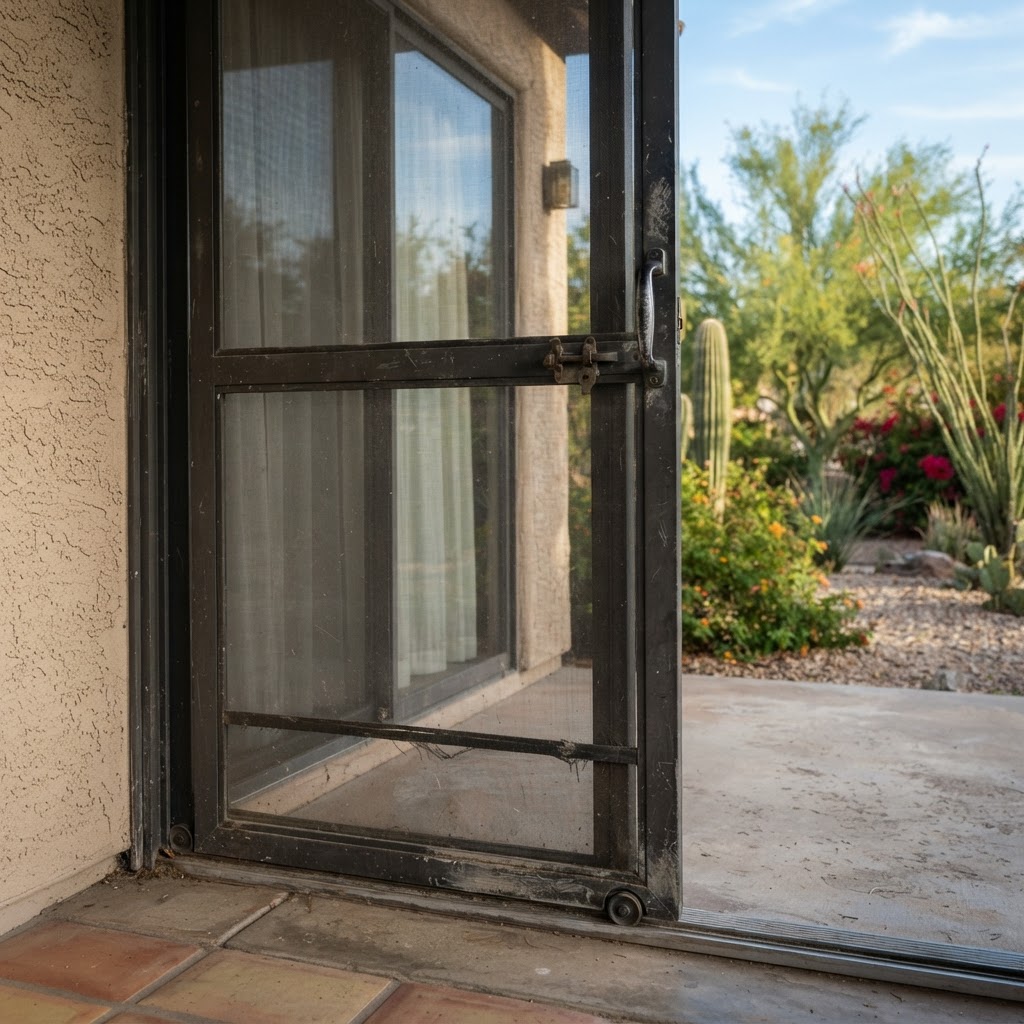
The most common screen door mistake for a busy entrance is choosing the door on appearance and price instead of on cycle count. A patio slider used twice a week and a back door used forty times a day are completely different mechanical problems. Buy the same door for both and the busy one fails first — usually within a year, usually at the rollers or the closer.
Here are the mistakes we see most often in Phoenix Valley homes, and what to specify instead.
Mistake 1: Plastic Rollers on a High-Traffic Door
Most budget screen doors ship with nylon or plastic wheels. Under light use they're fine. On a door that cycles dozens of times daily — especially in a home with kids and dogs — plastic wheels flat-spot, crack, and seize. Once a wheel seizes, the door drags on the track, the track wears a groove, and now you're replacing the track too.
Specify instead: steel or ball-bearing rollers with adjustable height. They cost slightly more up front and are the single highest-leverage upgrade on a busy door.
Mistake 2: A Lightweight Frame on a Door That Gets Slammed
Thin-wall aluminum frames rack out of square when a door is pushed open with a shoulder, a hip, or a knee — which is exactly how a busy family entrance gets used when someone's carrying groceries. Once the frame racks, the door binds in the track and stops latching.
Specify instead: heavy-gauge aluminum with reinforced corners. In Arizona, aluminum also outperforms vinyl frames, which get soft and warp under sustained summer heat.
Mistake 3: Standard Insect Mesh in a Pet or Kid Household
Standard fiberglass insect mesh tears the first time a dog pushes through it or a kid leans on it. Then it gets patched, then it tears again, and eventually the door looks bad enough that it gets replaced entirely — even though the frame was fine.
Specify instead: pet-resistant mesh (typically a heavier vinyl-coated polyester) in the lower panel at minimum, or throughout on doors at dog height. Some homeowners run a solid kick panel on the bottom third instead, which eliminates the problem outright.
Mistake 4: Skipping the Closer — or Using the Wrong One
On a swinging screen door, the closer is the component that determines whether the door survives. No closer means the door slams in Valley wind and racks its own frame. A too-strong closer means kids can't get through it and prop it open, which is worse. A closer with no hold-open feature means nobody can carry anything through.
Specify instead: an adjustable pneumatic closer with a hold-open detent, tuned so a child can open it but the wind can't slam it.
Mistake 5: Ignoring Which Way the Sun Hits It
This is the Arizona-specific one. A west-facing screen door takes hours of direct afternoon sun at 110°F-plus. That heat degrades vinyl components, dries out weatherstripping, and makes dark frames hot enough to be uncomfortable to touch. It also fades mesh unevenly, so the door stops matching the rest of the house.
Specify instead: on west- and south-facing entries, choose UV-stable mesh, powder-coated aluminum rather than painted, and avoid vinyl-heavy hardware. Consider a solar-screen mesh on the door itself if the entry gets brutal afternoon exposure.
Mistake 6: Measuring the Door Instead of the Opening
Homeowners routinely measure the existing screen door and order that size. If the old door was itself the wrong size — and on a resale home it often is — you've just bought the same mistake again. The opening is what matters, measured at three points for width and three for height, using the smallest reading.
Specify instead: measure the finished opening, not the old door. On out-of-square openings (common in older Valley homes and in stucco construction), a custom-built door is the only thing that will seal properly.
Mistake 7: Buying a Retractable Door for the Wrong Entry
Retractable screens are excellent on doors used moderately by adults. On a door that gets slammed, yanked, or used by kids and pets all day, the retraction mechanism and the mesh take abuse they weren't designed for. It's a great product in the wrong place.
Specify instead: a hinged or sliding door with heavy hardware for the busiest entry; save the retractable for the front door or a patio slider where the aesthetics matter more than the cycle count.
Quick Reference: Matching the Door to the Traffic
- Main family entrance, kids + pets — Best choice: Hinged aluminum with kick panel · Key spec: Steel rollers or heavy hinges, adjustable closer
- Patio slider used daily — Best choice: Sliding screen, heavy-gauge frame · Key spec: Ball-bearing rollers, pet mesh lower panel
- Front door, adults, curb appeal matters — Best choice: Retractable · Key spec: UV-stable mesh, smooth retraction housing
- Guest room or rarely used slider — Best choice: Standard sliding screen · Key spec: Standard mesh is fine here
- West-facing entry, heavy sun — Best choice: Hinged, powder-coated aluminum · Key spec: UV-stable mesh, no vinyl hardware
Get the Right Door the First Time
Window Screen Guys builds and installs custom screen doors across Phoenix, Scottsdale, Peoria, Surprise, Glendale, Cave Creek, Anthem, and North Phoenix. We use high-grade aluminum frames and metal wheels — not cheap plastic — because we're the ones who get called back when the budget door fails. Licensed Arizona contractor, ROC #362719.
Call (480) 771-6091 or request a free quote and we'll spec the right door for each entry in your home.
Frequently Asked Questions
What kind of screen door holds up best on a busy family entrance?
A hinged door with a heavy-gauge aluminum frame, reinforced corners, metal hardware, an adjustable pneumatic closer with hold-open, and pet-resistant mesh or a solid kick panel on the lower third. The frame weight and the closer matter more than any other spec on a high-cycle door.
Why does my sliding screen door keep coming off the track?
Almost always worn or seized rollers, a bent track, or a frame that has racked out of square. On a busy door, plastic rollers are the usual root cause. Replacing rollers with adjustable steel or ball-bearing wheels and straightening the track fixes most cases without replacing the door.
Are retractable screen doors good for homes with kids and dogs?
They work, but they're not the ideal choice for the single busiest door in the house. The retraction mechanism and the mesh take heavy abuse from repeated fast openings and from pets pushing at them. Retractables are best on front doors and moderately used patio sliders where appearance matters most.
Should I measure my old screen door or the door opening?
Measure the opening. Measuring the old door reproduces any sizing error it already had, which is common on resale homes. Take three width and three height measurements and use the smallest reading. Openings that are out of square need a custom-built door to seal correctly.
Does a west-facing screen door need different materials in Arizona?
Yes. West- and south-facing entries take hours of direct afternoon sun at extreme temperatures, which degrades vinyl components, dries weatherstripping, and fades mesh. Powder-coated aluminum frames, UV-stable mesh, and minimal vinyl hardware hold up significantly better on those exposures.
Need help with your windows?
Shop Screens2Go